
Choose a food trailer when you value a separate tow vehicle, flexible kitchen space, and the ability to leave the kitchen at a site. Choose a food truck when frequent moves and one self-contained vehicle matter more than separating the kitchen from the powertrain.
The better platform supports your menu, busiest service period, crew, recurring sites, storage, maintenance plan, driving requirements, and local approval path. A lower purchase price can become a poor value if the unit needs major changes or leaves the whole business parked during repairs.
The direct answer: a trailer favors flexibility; a truck favors frequent movement.
A food trailer is usually the stronger fit when you want the kitchen and tow vehicle to remain separate, need more layout flexibility, expect to stay at one site for a service period, or want the option to use the tow vehicle for other work. A food truck is often the stronger fit when the business changes locations frequently and the speed of arriving and leaving as one vehicle matters more than separating the kitchen from the engine and drivetrain.
Neither format is automatically cheaper, easier to license, or more profitable. A lightly equipped trailer can cost less than a complete truck, but a large commercial kitchen trailer plus a properly matched tow vehicle can reverse that comparison. A used truck can look affordable until engine, transmission, generator, refrigeration, plumbing, or body work is added. The honest comparison is the complete, ready-to-operate system—not two listing prices.
Write down the menu, equipment, crew, expected order volume, recurring sites, move frequency, parking constraints, storage plan, and who will drive or tow. Then ask which platform removes the most friction from a normal week.
- Choose a food trailer when separation matters.The kitchen can remain at the site while the tow vehicle leaves, and powertrain service does not automatically place the kitchen in the repair bay.
- Choose a food truck when movement is the main job.One self-propelled unit can reduce hitching and unhitching when the business changes locations several times a day.
- Pause when the answer depends only on appearance.Exterior style does not resolve equipment load, aisle width, driving class, parking, or approval requirements.
- Compare written specifications.List the exact equipment, utilities, ratings, condition, work still required, and what is included in each price.
Food trailer vs. food truck at a glance.
The table below is a planning tool, not a universal verdict. Trailer length, truck chassis, equipment package, build quality, menu, jurisdiction, and condition can change the result. Use it to identify which questions deserve a written answer before money changes hands.
| Decision area | Food trailer | Food truck |
|---|---|---|
| Kitchen and vehicle | Separate kitchen and tow vehicle | Kitchen and motor vehicle share one platform |
| Typical move | Hitch, inspect, tow, position, level, secure, and connect services as needed | Secure the kitchen, disconnect services, complete vehicle checks, and drive away |
| Workspace | Many sizes and floorplans; wheel boxes, tongue, porches, tanks, and equipment still affect usable space | Chassis, cab, wheel wells, drivetrain, and body shape compete with kitchen space |
| Powertrain failure | Tow-vehicle repair may leave the kitchen usable at an approved stationary site, subject to site rules and logistics | Engine or transmission repair can sideline the entire kitchen |
| Tow or driving plan | Requires a correctly rated tow vehicle, hitch, brake controller, loading plan, and qualified driver | Requires a driver qualified for the truck's class, dimensions, weight, and operating conditions |
| Parking and setup | Needs room to maneuver the complete combination and may require tow-vehicle parking after placement | Needs commercial-vehicle access and enough room for the body, service side, customer queue, and safe departure |
| Capital structure | Kitchen purchase plus tow vehicle, hitching equipment, registration, storage, and transport needs | Kitchen build plus chassis, engine, transmission, vehicle systems, registration, and commercial-vehicle maintenance |
| Best fit | Recurring sites, longer service periods, flexible layouts, separate vehicle use, or a menu needing more kitchen space | Frequent route changes, quick one-unit moves, compact service, or operators prioritizing a self-propelled platform |
“Food truck,” “food trailer,” “concession trailer,” and “mobile kitchen” are broad sales terms. Compare the actual floorplan, equipment schedule, utility loads, ratings, condition, documents, and operating plan.
Compare startup costs without relying on a made-up national average.
There is no single reliable nationwide price that answers whether a food trailer or food truck costs less. A number pulled from an article may combine shells with equipped kitchens, new units with old units, or purchase price with total startup cost. Geography, condition, equipment, professional work, permits, tax, insurance, vehicle needs, and transport make the real totals project-specific.
Use the same worksheet for both options. Begin with the exact unit. Add everything required to make it legal, safe, insurable, towable or drivable, and ready for the first month of service. Mark uncertain items as estimates and identify who will supply the final quote.
Compare the timing, too. An existing tow vehicle only reduces trailer cost if the complete combination is appropriate. A truck may eliminate a separate tow vehicle purchase while adding road-vehicle repair exposure. A low price is not a win if the equipment misses the menu or required corrections are outside the quote.
Choose the platform around the busiest fifteen minutes of service.
Exterior length does not equal usable kitchen space. In a trailer, wheel boxes, wall thickness, tanks, porches, cabinets, doors, windows, and equipment clearances shape the floor. In a truck, the cab, engine placement, wheel wells, chassis rails, fuel system, and body transitions can remove space or limit where heavy equipment is installed.
Draw the sequence for each high-volume item: cold storage, prep, cooking, holding, assembly, packaging, payment, and handoff. Add washing, restocking, trash, grease, and chemical storage. Assign each crew member a position and look for repeated crossings between the cook line, cold rail, sink, register, and window.
A trailer often offers more freedom to arrange work zones without a cab. A truck can still be an excellent kitchen, but inspect the cab, chassis, and kitchen transition rather than treating body length as open workspace.
Decide how often the kitchen will move—and who will move it.
A food truck is usually faster to leave with because the vehicle and kitchen are one unit. The crew still has to shut down appliances, secure loose items, close windows and awnings, disconnect utilities, check exterior clearances, and complete normal vehicle checks. A food trailer adds hitching, safety chains, breakaway equipment, electrical connection, brake-controller operation, jack and stabilizer work, and a walk-around of the complete combination.
That extra setup may be a small tradeoff for a trailer that stays at one brewery, food park, jobsite, campus, or event all day. It can be a major burden if the schedule requires several curbside stops. Write a real weekly route, including where the unit sleeps, who has keys, where the tow vehicle parks after placement, and whether each site has enough approach room to back, turn, level, serve, and exit safely.
Do not reduce the CDL question to one trailer weight.
The Federal Motor Carrier Safety Administration’s CDL class definitions consider the vehicle or combination and its weight ratings or actual weights. At the federal level, Class A generally covers a combination at or above 26,001 pounds when the towed unit exceeds 10,000 pounds; Class B generally covers a single vehicle at or above 26,001 pounds, including one towing a unit at or below 10,000 pounds. That does not mean every food trailer above 10,000 pounds automatically requires a CDL. The complete configuration, use, state rules, and any applicable exceptions matter. FMCSA’s official CDL question and answer illustrates why the power unit and towed unit must be evaluated together.
Record the truck and trailer ratings, expected loaded weights, hitch and payload limits, state of licensing, commercial use, and route. Then check the requirements with the driver-licensing and motor-carrier authorities responsible for the operation.
Price downtime as carefully as repairs.
A trailer still needs maintenance. Tires, brakes, axles, bearings, suspension, coupler, roof and seams, frame, doors, lights, plumbing, tanks, generator, refrigeration, HVAC, cooking equipment, hood, and suppression systems can all interrupt service. Separating the kitchen from the tow vehicle does not remove that work.
A food truck adds engine, transmission, steering, cooling, fuel, exhaust or emissions, starting, charging, and other road-vehicle systems to the same business asset as the kitchen. When the truck enters a repair bay, the kitchen usually goes with it. With a trailer, a failed tow vehicle may sometimes be replaced while the kitchen remains at an approved site—but only if the substitute vehicle, hitch, insurance, driver, and complete combination are appropriate.
Ask both sellers for maintenance access and records. Build a backup plan for refrigeration, electrical power, water, towing or roadside service, and the customer communication needed when a service day is lost. The best platform is not the one with no maintenance; it is the one whose maintenance risk the business can absorb.
Neither platform comes with a universal permit shortcut.
A food trailer and food truck can face many of the same food-safety questions: menu, preparation methods, sinks, water and wastewater, refrigeration, hot holding, surfaces, ventilation, fuel, suppression, commissary support, cleaning, storage, and operating procedures. The FDA’s Food Establishment Plan Review Guide is a useful framework for resolving equipment, plumbing, electrical, and mechanical issues before construction, but the reviewing agency for the intended location sets the actual submission and approval process.
Fire review can turn on the cooking equipment, hood and duct, suppression, propane, generator placement, clearances, extinguishers, emergency shutoffs, and inspection records—not simply whether the kitchen has an engine. The NFPA mobile food safety page offers a starting checklist for conversations with the local fire authority.
Zoning, vending, parking, property-owner permission, event rules, fire-lane access, customer queues, noise, generator use, wastewater disposal, and overnight storage may make a technically mobile unit unusable at a desired site. Ask the health, fire, zoning or planning, licensing, and transportation authorities about the exact menu, platform, address, and schedule. If an agency gives direction, keep it in writing and update the floorplan and quote when the design changes.
Do not promise that a unit approved in one city will be accepted unchanged in another. Confirm the first operating jurisdiction before buying, then repeat the check when the menu, equipment, fuel, or service territory changes.
Match the platform to a normal week of work.
| Operating pattern | Likely starting point | Why |
|---|---|---|
| Recurring food park or brewery site | Food trailer | Kitchen can stay positioned while the tow vehicle leaves; setup frequency may be low. |
| Several route stops in one day | Food truck | One self-propelled unit may shorten departures and reduce repeated hitching. |
| Festival and private-event calendar | Depends | Compare move frequency, site access, tow support, guest count, and the kitchen required for the menu. |
| Large crew and equipment-heavy hot line | Food trailer often leads | More length and layout freedom may help, but actual aisle, weight, ventilation, and site limits decide. |
| Compact beverage or dessert route | Either | A compact truck can move quickly; a small trailer can separate the business from the vehicle. |
| Owner needs the vehicle for supply runs | Food trailer | The tow vehicle can be available after placement where site and insurance rules allow. |
This matrix identifies a sensible first option, not a rule. A truck with a poor floorplan is not improved by frequent movement, and a trailer that cannot reach its recurring sites is not flexible. Test the actual unit against the actual route.
If a trailer fits, decide whether in-stock, used, or custom fits next.
BJP Trailers focuses on trailers rather than food trucks. If the comparison points toward a trailer, the next decision is whether a real in-stock unit already matches the operating brief, a used unit can be verified and adapted responsibly, or the kitchen needs a custom floorplan. Apply the same menu, crew, utility, weight, towing, site, and local-review questions to all three paths.
Compare the exact unit.
Verify current status, physical location, price, VIN or stock reference, dimensions, ratings, equipment, utilities, condition, and what is included before traveling.
Shop BJP inventoryInspect the history and changes.
Review title, frame, roof, seams, axles, tires, brakes, wiring, plumbing, tanks, appliances, ventilation, suppression, repairs, modifications, and service records.
View used trailersPrice a written operating brief.
Provide the menu, equipment models, layout, crew, utilities, finish, weight, tow plan, local-review notes, destination, and target timing.
Plan a custom food trailerFor any listing, ask what work remains before service. A trailer with the right dimensions but the wrong electrical service, ventilation, equipment, water capacity, or loaded-weight plan is not a close match. Call BJP to confirm the current price, availability, equipment, specification, and physical location before traveling.
Compare three real trailer footprints—not generic renderings.
BJP’s listing pages use real photographs and published details. These examples show how dramatically the platform can change before equipment and crew are added. They are layout references, not a promise of current availability; call to verify status, price, equipment, location, and specifications.
6×12 orange trailer #77684
A smaller single-axle footprint makes buyers confront menu focus, storage, appliance clearances, water, and one- or two-person workflow.
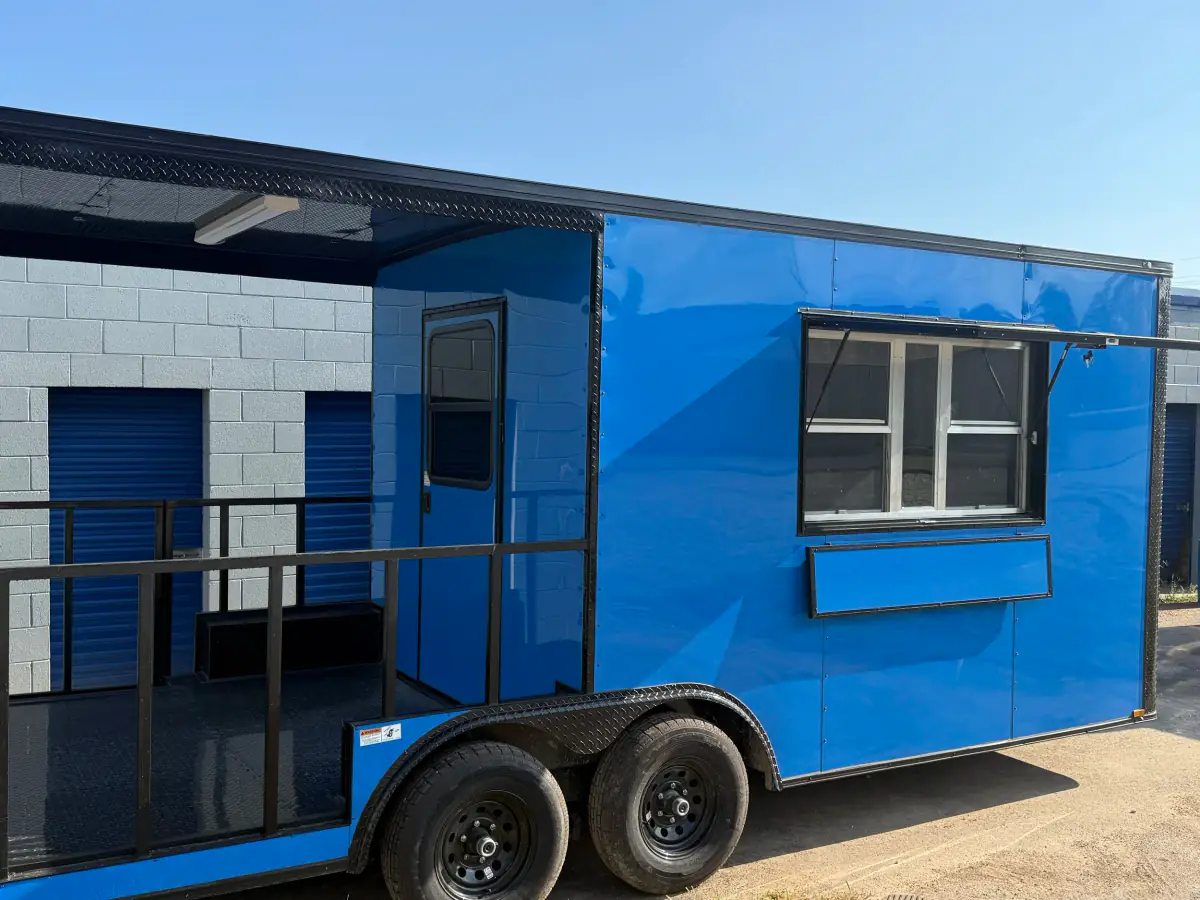
See real photos8.5×20 blue porch trailer #67093
A porch changes exterior equipment planning, travel preparation, site depth, approach angles, customer-side use, and weather exposure.
See real photos8.5×24 grey-blue trailer #70673
A longer body can create more work zones, but also raises questions about loaded weight, turning room, parking, crew discipline, and utilities.
See real photosWrite the answers before shopping.
Complete this worksheet for the first year you expect to operate, not an ideal future version of the business. Where the answer is unknown, identify who can confirm it. The pattern should reveal whether the business needs the separation and layout flexibility of a trailer or the move frequency of a truck.
- Menu and volume: What is cooked, held, assembled, packaged, and washed during the busiest fifteen minutes?
- Crew: How many people work inside, and which stations must operate at the same time?
- Movement: How many moves happen in a normal day and week? How long can setup and departure take?
- Sites: Record gates, turns, slopes, overhead clearance, service-side space, queue area, parking, utilities, and overnight rules.
- Equipment and utilities: List models, dimensions, power, fuel, water, wastewater, ventilation, suppression, and service access.
- Vehicle and driver: For a trailer, identify the tow vehicle, ratings, hitch, brake controller, loading, insurance, and driver. For a truck, identify chassis ratings, license needs, and service support.
- Downtime: Decide what happens when the kitchen, tow vehicle, truck powertrain, generator, or refrigeration needs repair.
- Local review: Name the health, fire, zoning, licensing, and parking authorities for the first operating address.
- Complete cost: Compare ready-to-operate totals, transport or pickup, corrections, startup reserve, and the cost of lost service days.
- Buying path: Decide whether a verified in-stock or used trailer fits, or whether the work sequence requires custom planning.
BJP Trailers has one Springfield, Missouri show lot. Buyers can inspect real inventory, arrange pickup, or request transport pricing to an exact address nationwide. Transport is quoted for the specific trailer and destination; access, timing, route, and receiving conditions can affect the plan.
Did the worksheet point toward a food trailer?
Send BJP your menu, crew, equipment, tow plan, local-review notes, budget, and destination. The team can compare real listings or organize a custom-trailer conversation.
Questions buyers ask before choosing a mobile kitchen.
Is a food trailer or food truck better?
A trailer is often better for a business that values a separate tow vehicle, flexible kitchen space, and longer service periods at each site. A truck is often better when the route requires frequent moves and leaving as one self-propelled unit matters most. The menu, crew, sites, budget, driver, and maintenance plan determine the final choice.
Which costs less: a food trailer or a food truck?
There is no reliable universal answer. Compare the complete ready-to-operate systems. For a trailer, include the tow vehicle, hitching and braking equipment, kitchen completion, registration, storage, and transport. For a truck, include the chassis and powertrain condition, kitchen, vehicle registration, commercial-vehicle maintenance, and repairs. Add permits, insurance, inventory, payroll, and reserve to both.
Does a food trailer over 10,000 pounds always require a CDL?
No. The federal Class A definition generally involves a combination at or above 26,001 pounds when the towed unit exceeds 10,000 pounds; the trailer number alone does not settle the question. Ratings or actual weights, configuration, commercial use, state rules, and possible exceptions matter. Check the exact rig with the appropriate driver-licensing and motor-carrier authorities.
Can a food truck tow an additional trailer?
Possibly, but it should never be assumed. Confirm the truck manufacturer’s ratings, hitch, payload, axle loads, braking, overall dimensions, combined weight, license class, insurance, route restrictions, and local operating rules. Towing can also change maneuvering, parking, maintenance, and the value of choosing a self-contained truck in the first place.
Which platform usually has more kitchen space?
Trailers often offer more freedom to choose length and arrange work zones because they do not contain a cab and road powertrain, but the real answer depends on the units being compared. Wheel boxes, porches, tanks, cabinets, doors, chassis components, equipment clearances, and aisle width all reduce usable space.
Is a food trailer easier to permit than a food truck?
Not automatically. Health, fire, zoning, parking, vending, and licensing decisions depend on the menu, equipment, utilities, fuel, operating procedures, site, and jurisdiction. Ask the agencies responsible for the first operating location to review the proposed platform and plan before purchase or construction.
What happens when the vehicle needs repair?
With a food truck, engine or transmission work can place the entire kitchen in the repair shop. With a trailer, tow-vehicle work may leave the kitchen usable at an approved stationary site or allow a suitable replacement tow vehicle. The trailer still has its own running gear and kitchen systems that require maintenance, so both formats need a downtime plan.
Should I buy an in-stock, used, or custom food trailer?
Choose the path that matches the written operating brief. In-stock works when the exact unit fits the menu, crew, utilities, tow plan, sites, and local review. Used can work when condition, records, equipment, and required changes are clear. Custom is useful when the workflow needs a specific layout. Verify every inclusion and current listing detail in writing.
Does BJP work with food trailer buyers outside Missouri?
Yes. Buyers can review real BJP listings online, visit the Springfield show lot, arrange pickup, or request transport pricing to an exact address nationwide. Call before traveling to confirm current availability, physical location, price, equipment, and specifications for the trailer you want to inspect.
Resources referenced in this guide.
- FDA: Food Establishment Plan Review Guide
- FMCSA: Commercial Driver’s License Classes and Endorsements
- FMCSA: Official CDL Classification Question and Answer
- National Fire Protection Association: Food Truck Safety
These federal and national resources are planning starting points. State and local authorities determine the requirements that apply to a specific driver, vehicle combination, kitchen, menu, and operating location.